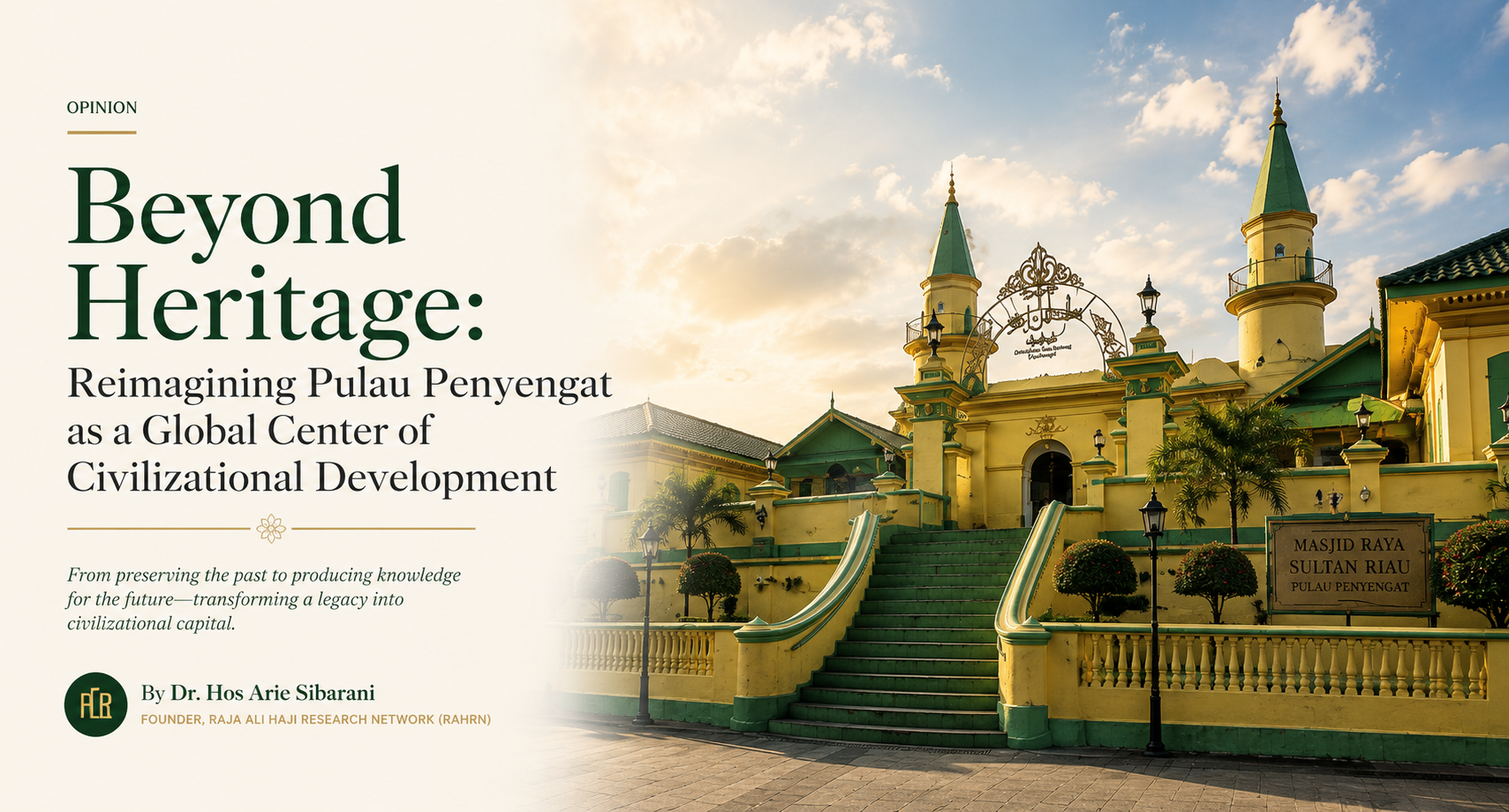
Pulau Penyengat has long occupied a distinguished place in the historical memory of the Malay world. Visitors cross the narrow strait to admire the iconic Sultan Riau Mosque, visit the resting place of Raja Ali Haji, and experience an island that once stood at the heart of the Riau-Lingga Sultanate. Yet, despite its immense historical significance, Pulau Penyengat is still largely understood through the lens of heritage tourism. It is remembered for what it was, rather than envisioned for what it could become.
This perspective is no longer sufficient.
The twenty-first century is defined not by the ownership of natural resources alone, but by the ability of societies to create knowledge, generate innovation, and cultivate ethical leadership. Nations that succeed are increasingly those capable of transforming their cultural and intellectual heritage into strategic assets for sustainable development. In this global context, Pulau Penyengat deserves to be reimagined—not simply as a preserved historical island, but as a living center of knowledge and civilizational renewal.
More than a century ago, Raja Ali Haji articulated a vision of civilization grounded in morality, language, and learning. In Gurindam Dua Belas, he wrote:
"Jika hendak mengenal orang yang berbangsa,
lihat kepada budi dan bahasa."
— Gurindam Dua Belas
"If you wish to understand the character of a people,
look to their virtue and their language."
(Author's translation)
These lines express a profound civilizational principle. The greatness of a people is not determined solely by wealth or political power but by the quality of their ethical conduct and intellectual culture. Language is more than a communication tool; it carries values, identity, collective memory, and a society's understanding of justice and humanity.
Pulau Penyengat embodies precisely this intellectual inheritance. It was here that Raja Ali Haji produced Gurindam Dua Belas, Bustan al-Katibin, Muqaddimah fi Intizam Waza'if al-Malik, Tsamarat al-Muhimmah, and Tuhfat al-Nafis. These works explored constitutional ethics, governance, history, education, language, and leadership, demonstrating that the Malay world developed a sophisticated tradition of political and ethical thought long before many modern constitutional states emerged in the region.
Unfortunately, contemporary development strategies continue to treat this remarkable legacy primarily as a tourism asset. Heritage conservation remains indispensable, but preservation alone cannot sustain a civilization. Monuments may survive for centuries, yet civilizations endure only when their ideas continue to be interpreted, debated, and applied by succeeding generations.
The challenge, therefore, is not merely to conserve Pulau Penyengat but to activate its intellectual potential.
This requires a fundamental shift in development thinking. Rather than viewing heritage as an endpoint of preservation, we should recognize it as the beginning of knowledge production. Cultural heritage should function as civilizational capital—a strategic resource capable of generating research, innovation, education, and social transformation.
Such a perspective invites a new model of development. Pulau Penyengat should become a Center of Thought, where scholars, policymakers, educators, artists, and community leaders engage with the intellectual legacy of Raja Ali Haji to address contemporary questions of governance, ethics, constitutionalism, language, education, and maritime civilization.
It should also become a Knowledge Production Hub, producing internationally recognized research, scholarly publications, digital archives, manuscript preservation projects, conferences, policy dialogues, and collaborative academic networks connecting Southeast Asia with the wider world.
Most importantly, Pulau Penyengat should evolve into a Living Laboratory of Civilizational Development. Here, ideas would not remain confined to libraries or academic journals. They would be translated into educational innovation, digital humanities, cultural entrepreneurship, creative industries, community empowerment, and sustainable tourism. Heritage would become a catalyst for development rather than merely an object of conservation.
This approach represents a different philosophy of development. Conventional development often measures success through infrastructure, investment, or visitor numbers. These indicators remain important, but they do not fully capture what makes societies resilient and prosperous over the long term. Roads, ports, and buildings can stimulate economic activity, yet they cannot by themselves create civilization.
Civilizations are built through ideas.
They are sustained through education.
They flourish through ethical leadership.
They endure through institutions capable of transmitting knowledge across generations.
This understanding is increasingly reflected in global discussions surrounding cultural sustainability and the knowledge economy. Around the world, heritage cities are redefining themselves as innovation ecosystems where history serves as the foundation for future creativity. Pulau Penyengat possesses all the essential ingredients to follow this path, yet with one distinctive advantage: its development can be rooted in one of Southeast Asia's richest intellectual traditions.
Realizing such a vision requires collaboration rather than isolated initiatives. Government must provide long-term policy commitment and infrastructure. Universities should establish permanent research programs, postgraduate centers, and international collaborations focused on Malay intellectual history. Cultural organizations should preserve authenticity while embracing innovation. Creative industries can transform historical narratives into educational technology, publishing, film, digital exhibitions, and cultural tourism. Local communities, meanwhile, must remain at the center of this transformation, serving not merely as custodians of heritage but as active producers of knowledge and innovation.
The measure of success should therefore evolve as well. The future of Pulau Penyengat should not be judged solely by the number of visitors arriving each year. It should also be assessed by the number of research projects undertaken, scholarly publications produced, international partnerships established, young researchers trained, digital innovations created, and policy ideas inspired by its intellectual tradition.
Pulau Penyengat once gave the Malay world Raja Ali Haji—scholar, historian, linguist, statesman, and one of the greatest intellectual figures in Southeast Asian history. Today, the island has an opportunity to contribute something equally significant: a globally relevant model of Civilizational Development, demonstrating how cultural heritage can become the foundation of knowledge production, ethical governance, innovation, and sustainable prosperity.
In an era when societies around the world are searching for development models that balance economic progress with cultural identity and moral purpose, Pulau Penyengat offers more than historical nostalgia. It offers an alternative vision.
Not a civilization trapped in the past.
But a civilization that continues to think.
To create.
To educate.
And to inspire.
That, perhaps, is the greatest tribute we can pay to Raja Ali Haji—not merely by preserving the island where he lived, but by ensuring that the intellectual spirit he cultivated continues to illuminate Indonesia and the world.
"From Penyengat, We Preserve Heritage, Produce Knowledge, and Build Civilization."
— Dr. Hos Arie Sibarani