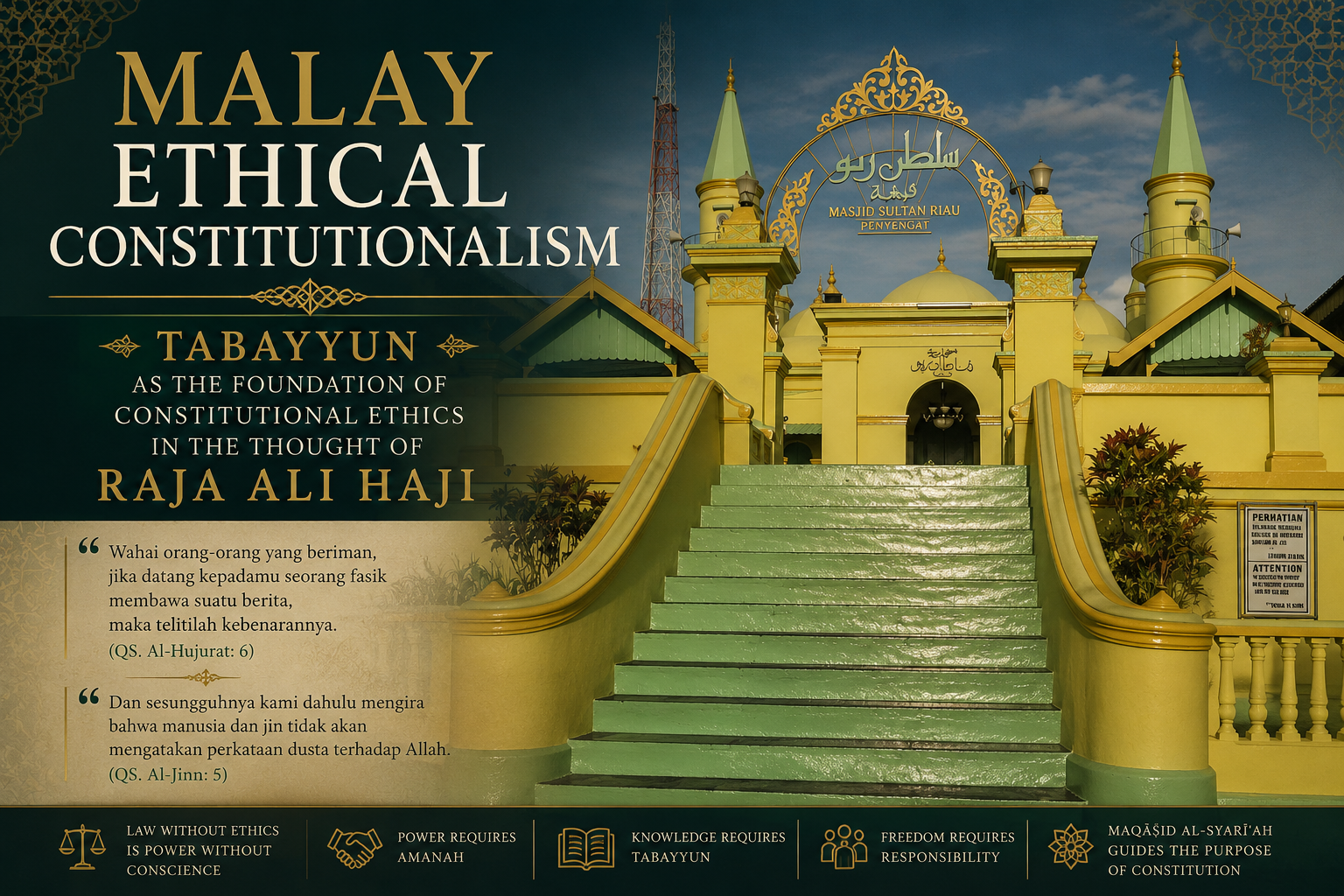
When discussing constitutionalism, our attention is almost invariably directed toward the Magna Carta, Montesquieu, John Locke, or other prominent Western political thinkers. Yet, long before constitutionalism emerged in its modern sense, the Malay world had already produced a thinker who laid the foundations of ethical governance, governmental responsibility, and public morality: Raja Ali Haji (1808–1873).
Raja Ali Haji is widely recognized as a literary scholar, linguist, and the author of Gurindam Dua Belas. However, when his works are examined as a whole—particularly Tsamarat al-Muhimmah and Muqaddimah fi Intizam Waza'if al-Malik—it becomes evident that he was constructing a far more comprehensive intellectual framework: one that explains how political authority should be exercised on the basis of trustworthiness (amanah), knowledge, justice, and ethical conduct (adab).
It is this intellectual framework that I refer to as Malay Ethical Constitutionalism—a conception of constitutionalism that is not confined to limiting governmental power through legal norms, but also emphasizes the cultivation of the moral character of both rulers and society. Within the Malay-Islamic tradition, the constitution does not merely exist in legal texts; it is embodied in ethical values. Among the most fundamental of these values is tabayyun.
Allah the Almighty declares:
"O you who believe! If a wicked person comes to you with news, verify it..." (Qur'an 49:6).
This verse is commonly understood as a command to verify information. Yet its significance is much deeper. Tabayyun represents an Islamic epistemological method—a process of acquiring sound knowledge before forming beliefs, making decisions, or taking action.
The same principle is reaffirmed in Surah Al-Jinn:
"Indeed, we had assumed that humans and jinn would never attribute falsehood to Allah." (Qur'an 72:5).
The confession of the believing jinn is a profound lesson in intellectual humility. They realized that they had once accepted people's claims about Allah without verification. Only after listening to the Qur'an did they recognize their mistake.
This verse teaches that even in matters of faith, assumptions must never replace evidence. Popularity must never replace truth. Tradition must never supersede revelation.
For this reason, tabayyun is not merely an ethic of communication; it is the foundation of civilization.
Raja Ali Haji and the Malay Epistemological Tradition
These values have long been embedded within the Malay intellectual tradition. Raja Ali Haji opens Gurindam Dua Belas with a powerful reminder:
Barang siapa tiada memegang agama, sekali-kali tiada boleh dibilangkan nama.
For Raja Ali Haji, religion is not merely a social identity. It is the moral compass that guides human beings in thinking, speaking, and acting.
He further writes:
Apabila terpelihara mata, sedikitlah cita-cita.
Apabila terpelihara lidah, niscaya dapat daripadanya faedah.
In the twenty-first century, safeguarding one's eyes means exercising discernment regarding the information one consumes. Guarding one's tongue means refraining from spreading information whose truth has not been established. In this sense, the ethical teachings of Raja Ali Haji constitute nothing less than a culture of tabayyun.
He understood that the decline of society often begins not with the weakness of law, but with the deterioration of the moral character of those entrusted with implementing it.
Tabayyun as a Constitutional Principle
Modern constitutional theory derives governmental legitimacy from law, institutional arrangements, and constitutional procedures. Raja Ali Haji, however, offers a deeper dimension.
Power is not legitimate merely because proper procedures have been followed.
Power must also be moral.
Consequently, tabayyun is not merely an individual obligation; it is a constitutional principle.
Judges must practice tabayyun when evaluating evidence.
Governments must exercise tabayyun before adopting public policies.
Journalists must undertake tabayyun before publishing news.
Academics must practice tabayyun before presenting scholarly conclusions.
Citizens must engage in tabayyun before believing and disseminating information.
In this way, tabayyun functions as an ethical mechanism that prevents power from degenerating into arbitrariness and freedom from descending into disorder.
Maqāṣid al-Sharī'ah and the Culture of Verification
From the perspective of maqāṣid al-sharī'ah, tabayyun is not merely an individual virtue but an instrument for realizing the higher objectives of Islamic law.
Through tabayyun, religion (ḥifẓ al-dīn) is protected from distortion.
Reason (ḥifẓ al-'aql) is safeguarded against manipulation and ignorance.
Human life (ḥifẓ al-nafs) is preserved from conflict arising from slander and misinformation.
Property (ḥifẓ al-māl) is protected from fraud and decisions based upon false information.
Even human dignity (ḥifẓ al-'irḍ) is safeguarded, for Islam strictly prohibits accusations unsupported by evidence.
Viewed through this lens, tabayyun serves as a bridge between divine revelation and public welfare. It connects the normative principles of Islam with practical governance, social life, and public administration.
Malay Ethical Constitutionalism
I argue that the Malay intellectual tradition extends far beyond literature and moral instruction. It contains a distinctive constitutional philosophy.
If modern constitutionalism emphasizes the rule of law, Malay Ethical Constitutionalism introduces an equally indispensable dimension: the rule of ethics.
Law requires ethics.
Power requires trustworthiness (amanah).
Liberty requires responsibility.
Knowledge requires tabayyun.
These four elements are mutually reinforcing.
A constitution without ethics produces a dry and mechanical legalism.
Ethics without law lacks institutional force.
Accordingly, the two must operate in harmony.
Today, amidst an unprecedented flood of information, artificial intelligence, and algorithm-driven communication, humanity's greatest challenge is no longer the scarcity of information but the scarcity of wisdom in verifying it.
Raja Ali Haji reminded us that ethical conduct is the foundation of knowledge.
The Qur'an teaches that tabayyun is the pathway to truth.
The objectives of Islamic law demonstrate that verification is not merely an intellectual exercise but an essential means of safeguarding religion, reason, life, property, and human dignity.
It is therefore time to revisit the intellectual heritage of Penyengat—not as an object of historical nostalgia, but as a vision for the future.
The Malay world possesses a significant contribution to global constitutional thought: a constitutionalism concerned not only with the distribution of power but also with the cultivation of character, trustworthiness, ethical conduct, and moral responsibility.
It is here that Malay Ethical Constitutionalism finds its enduring relevance.
It reminds us that the strongest constitution is not merely the one written in the legal documents of the state, but the one inscribed within the conscience of its citizens.
That conscience is shaped by knowledge, refined through ethical conduct, and sustained by the enduring culture of tabayyun.