When Penyengat Teaches the Ethics of Journalism
FESMED, Raja Ali Haji, and Malay Ethical Constitutionalism
By Dr. Hos Arie Sibarani
Artificial intelligence can now write news stories within seconds. Algorithms determine what appears on our screens. Social media has transformed every individual into a potential reporter, editor, and publisher. Yet amid this technological revolution, one fundamental question remains unanswered: Who teaches responsibility to words?
Artificial intelligence can generate information. But it cannot bear moral responsibility. Algorithms can decide what we read. They cannot determine whether information serves justice. Silicon Valley teaches machines how to think. More than a century ago, however, Penyengat Island taught human beings how to be accountable for their thoughts.
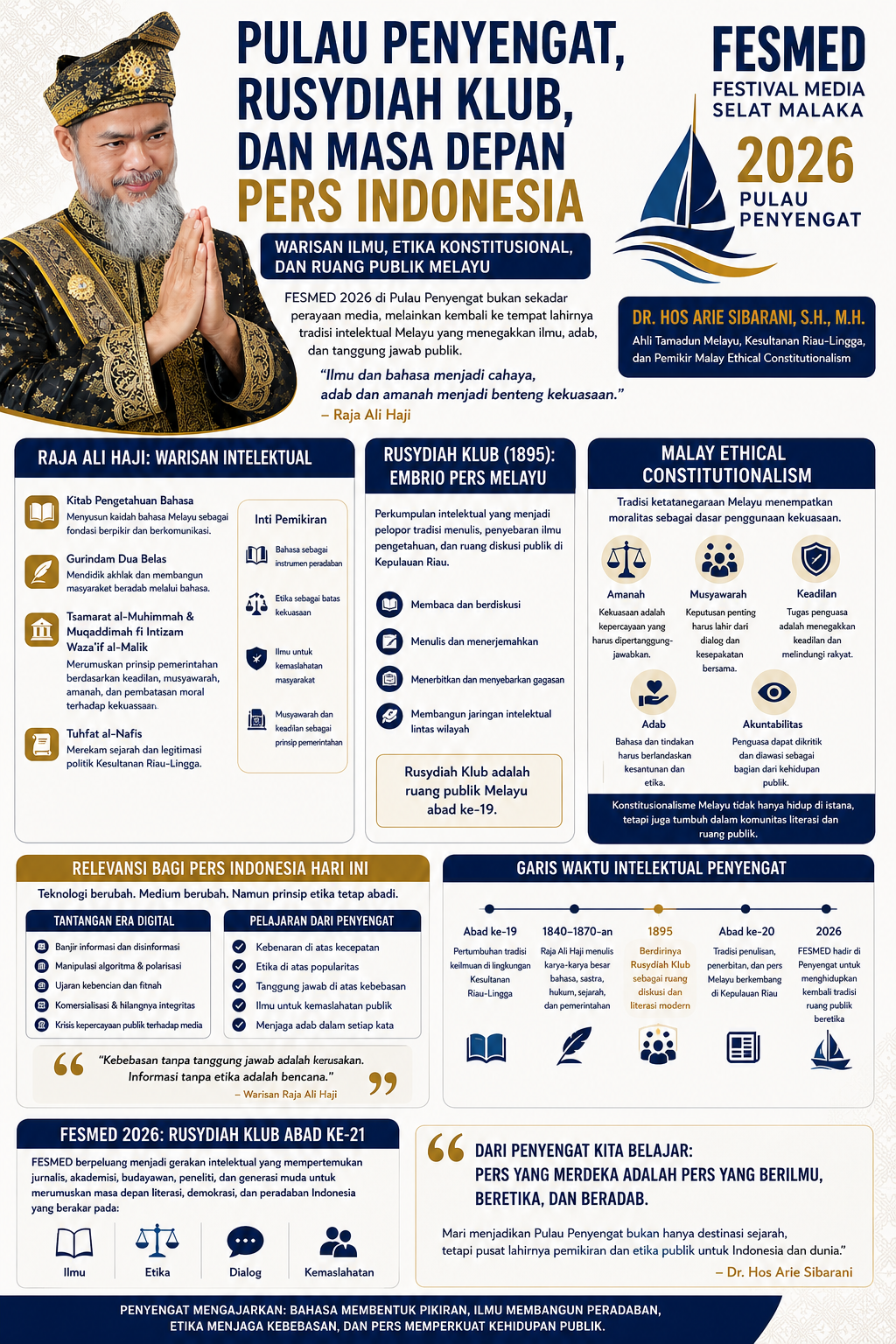
This, perhaps, is the deepest meaning behind the decision to hold the 2026 Malacca Strait Media Festival (FESMED) on Penyengat Island. The festival is not merely taking place at a historical site; it symbolically brings together two eras confronting the same challenge: the nineteenth century, when Raja Ali Haji cultivated a sophisticated tradition of Malay literacy, and the twenty-first century, when humanity struggles to preserve truth in the age of digital disruption.
Penyengat is far more than a small island in the Malacca Strait. It was one of the greatest intellectual centres of the Malay world. From this island emerged the monumental works of Raja Ali Haji—Gurindam Dua Belas, Kitab Pengetahuan Bahasa, Tsamarat al-Muhimmah, Muqaddimah fi Intizam Waza'if al-Malik, and Tuhfat al-Nafis. These texts shaped not only the development of the Malay language but also articulated profound ideas about governance, ethics, public responsibility, and constitutional order.
Raja Ali Haji's greatest legacy was not simply language itself. It was the ethics of language. For him, words were never neutral. Words were a trust. And trust is the foundation of civilisation.
Language as a Moral Constitution
Constitutions are commonly understood as legal documents governing the relationship between the state and its citizens. That understanding is correct—but incomplete. My research on Raja Ali Haji's constitutional thought suggests a broader conception. In the Malay intellectual tradition, constitutionalism is not confined to written legal texts. It is equally sustained by ethical principles that guide the exercise of power and shape public life.
I describe this tradition as Malay Ethical Constitutionalism. Within this framework, constitutionalism is not merely institutional. It is moral. It operates through five interconnected principles: Trust (Amanah), Justice ('Adl), Deliberation (Musyawarah), Civility (Adab), and the Public Good (Maslahah).
Accordingly, the endurance of a constitutional order depends not only upon legal institutions but also upon the moral quality of its public sphere. Language therefore acquires constitutional significance. Words do more than communicate ideas. They shape the ethical imagination of society. When language loses its civility, constitutional life itself begins to erode.
Rusydiah Club and the Birth of the Malay Public Sphere
Raja Ali Haji's intellectual achievements did not emerge in isolation. They flourished within a vibrant scholarly ecosystem. In 1895, Rusydiah Club was established as a society of Malay scholars, jurists, poets, historians, linguists, and administrators. Members gathered to read, debate, translate, edit, publish, and circulate knowledge throughout the Malay world.
Rusydiah Club was far more than a literary association. It functioned as an intellectual public sphere. Long before modern political theory introduced the concept of the *public sphere*, Penyengat had already cultivated a culture of dialogue grounded in scholarship, ethical disagreement, and public responsibility.
From the perspective of Malay Ethical Constitutionalism, Rusydiah Club formed part of what may be called the **constitutional ecosystem**. Constitutional life was not preserved solely by rulers or judges. It was equally sustained by communities committed to knowledge, ethical discourse, and civic virtue.
From Watchdog to Moral Compass
For over a century, journalism has often been described as the watchdog of democracy. The metaphor remains important. A free press scrutinises power, exposes corruption, and safeguards accountability. Yet today this role alone is no longer sufficient.
Malay Ethical Constitutionalism invites us to rethink journalism beyond surveillance. The press should not merely bark when power goes astray. It should also illuminate the direction in which society ought to move. Journalism must become more than a watchdog. It must become a moral compass.
Its task is not only to expose wrongdoing but also to cultivate trust, preserve dignity, and nurture ethical public conversation. Technology may accelerate communication. Only moral responsibility can sustain civilisation.
The Penyengat Formula
From Raja Ali Haji's intellectual legacy emerges a remarkably simple yet profound insight. Knowledge produces civility. Civility generates trust. Trust builds civilisation. This may be called the Penyengat Formula:
> Knowledge → Civility → Trust → Civilisation
Civilisation is not ultimately constructed by political power. It is constructed by public trust. And trust can flourish only where knowledge is guided by ethics. The crisis confronting contemporary journalism is therefore not primarily a crisis of technology. It is a crisis of trust. Societies today are overwhelmed by information, yet increasingly deprived of wisdom.
Beyond Freedom of Speech
Modern constitutional democracies rightly celebrate freedom of expression as a fundamental right. The Malay intellectual tradition does not reject this principle. Rather, Raja Ali Haji adds a dimension often overlooked in contemporary discourse: Every freedom carries a moral responsibility. Rights and duties are inseparable.
Within Malay Ethical Constitutionalism, freedom of the press rests upon five ethical foundations:
Amanah (Trust):** Information is a public trust rather than a commercial commodity.
Justice ('Adl):** Reporting must respect fairness, truthfulness, and human dignity.
Musyawarah (Deliberation):** Journalism should cultivate dialogue rather than deepen polarisation.
Adab (Civility):** Language must elevate public discourse instead of degrading it.
Maslahah (Public Good):** The ultimate purpose of communication is the welfare of society.
These principles are not merely cultural values inherited from the Malay world. They offer a normative framework for journalism in the twenty-first century.
Towards a Twenty-First Century Rusydiah Club
This is why FESMED should not end as an annual festival. It should become the starting point for a new intellectual movement. What Indonesia—and perhaps the wider world—needs today is a Twenty-First Century Rusydiah Club: a community that brings together journalists, scholars, writers, historians, digital innovators, and civil society to safeguard the ethical quality of the public sphere.
Not another bureaucratic institution. But a moral movement. A movement that measures journalism not merely by speed, but by trust. Not merely by clicks, but by integrity. Not merely by influence, but by its contribution to civilisation.
Conclusion
Penyengat offers a lesson that has become even more relevant in the age of artificial intelligence. Technology can distribute information at unprecedented speed. Only human beings can transform information into wisdom. Before pressing post, share, or publish, we might recall Raja Ali Haji's enduring reminder:
Every word is a trust. The rise and fall of a civilisation rarely begins with armies. More often, it begins with a sentence that people choose to believe. Algorithms may determine what we read. But civility determines who we become after reading it.
Opinion
When Penyengat Teaches the Ethics of Journalism FESMED, Raja Ali Haji, and Malay Ethical Constitutionalism
Author
Dr. Hos Arie Rhamadhan Sibarani
Published
Publication date unavailable
Topic
Law and Public Affairs